Aussie Pink Floyd

What’s going on when I’m playing music I’ve known all my life – playing it either in my head or in iTunes? It’s something quite different from when I’m listening to something new; it’s a kind of comfort, a predictable sequence, a memory test I know I’ll pass: every lyric, every inflection, every percussive emphasis and fill – all these play back in their precise order and on cue. Detailed familiarity – not exactly relaxing, but giving some kind of comfort. Which is where tribute bands come in, for these Aussies the other night at the O2 did something the real Pink Floyd wouldn’t do – copying, live, every beat, tone and colour of the studio album. The first part – a playthrough of Dark Side of the Moon in honour of its 40th anniversary, matched to a perfect level my parallel mental track (all I noticed different was the guitar/falsetto game at the end of “Money” became guitar/guitar). The projected images were nicely updated: partly Australian jokes and partly filmclips cleverly kept in the early 70′s. The rest of the concert kept a disciplined, beautifully slavish adherence to the original; just in the encore the singer in the middle allowed himself “cannot” for “can’t” – tiny, but through its uniqueness it had the power of the raised voice in the last verse of Tom Waites’ “Missing You”, a tiny release of suppressed emotion which all by itself inspired Kazuo Ishiguro’s The Remains of the Day.

Cover versions are fascinating in their bringing together of the old and the new: one’s mental track has to sit with, to absorb, newness, in the way some literature (all literature?) more or less openly derives from older works. New wine in old bottles.

But carbon-copy tribute versions can bring new flavours: hearing Dark Side like this made me realise for the first time perhaps the way it deals with death as much as with madness: what else is “The Great Gig in the Sky”? And “Breathe (Reprise)” – at the end of “Time” – always reminds me of death – the church and the fields for me evoke the end of Larkin’s “Days“. And the album’s dramatic focus, revealed at this concert by the staging as well as by the song itself, is clearly the sequence of “Us and Them”, the musically most challenging “Any Colour You Like”, and “Brain Damage”, where we get the self-referential

And if the band you’re in starts playing different tunes
I’ll see you on the dark side of the moon.

Then we are left with the more straightforward build-up to the climactic triumph of lunacy in “Eclipse” (“But the sun is eclipsed by the moon”) – Sid’s back.

The concert then had bits of the Wall, the whole of “Echoes” (I’d never before realised the urgent and pressing power of this song’s vocal line), some later songs I didn’t know, before ending with “Comfortably Numb” and, as encore, “Run Like Hell”. “Comfortably Numb” was done well, its nostalgic lyrics of childhood still powerful (Lawrence’s “I weep like a child for the past”).

But what got me most that evening were the three female singers – wonderful backing voices, stellar as leads in “Great Gig” – but the way they moved… a range of choreographed hand and arm gestures, fitted perfectly to each part of each song, and making them look like mermaids or sea anemones. OK – they were, in theory, sexistly conventionalised candy (the men wore tee shirts and stood motionless, the girls changed dresses every song or two and were constantly gyrating), but as it was they were theatrically more than that: have a look.

Posted in Concert | Tagged , , , | Leave a comment

Consciousness: A performance lecture by Marcus du Sautoy, featuring music by James Holden

Barbican Hall. Two halves. Probably meant to be Left and Right: the first was an illustrated lecture on where brain science is today; the second a longish performance of some world-music-type music, designed to see if this could alter our brain states; I don’t think it altered mine.

The most interesting material in the first half was the mirror test. To see if organisms were self-aware, blobs of coloured paint were surreptitiously dabbed on subjects’ foreheads, which were then placed near mirrors. When they saw themselves, did their hands go up to their own heads to investigate the unusual colour, or to the heads in the mirrors?
Results:

Chimpanzees & orang utans more or less all show self-awareness in this way.
Bizarrely, SOME elephants, whales & magpies do same.
Humans start showing self-awareness in this way between 16 & 22 months; but self-conscious behaviour (e.g shyness) is different – earlier.
Chimpanzees LOSElose this self-awareness at c.15 years old. Is this an adaptation to stop them thinking of their own deaths? [Alzheimer’s…?]

It’s hard to know exactly though what all this shows, and what exactly self-awareness is. Presumably animals and infants can’t verbally express, even to themselves, what they are understanding, and presumably even lower organisms have some kind of self-awareness, or they wouldn’t lick their wounds or be able to function properly.

Other points:

Twins in the womb are aware of the identity of their sibling: they don’t kick each other as hard as they do their mums.

Vision dominates. This was powerfully demonstrated by a film of Marcus pronouncing “duh”, “buh” and “puh “(I think) with a soundtrack of him saying just “duh”, each time. We all heard it as our eyes told us, as three different sounds, ignoring the contradictory evidence of our ears.

Posted in Lecture | Tagged , , | Leave a comment

“On the Saltmarsh” by Ruth Valentine

[Poetry Café, 25th January]

Paul and I stumbled into the Poetry Café and caught the second half of Ruth Valentine’s reading from On The Saltmarsh, bumping into Paul’s sister-in-law as we did so.

The main reason I guess for hearing poetry live is the greater frequency of “ooooh” moments – when the combination of words and inflection make your tummy go; and there were loads on this particular night.

Ruth’s poems are largely about the really unpleasant sides of current affairs: refugees, asylum-seeking, rendition, torture, war, bombs, and she addresses these issues from personal experience, as well as using the traditional poets’ toolkit of myth and objective correlative.

The book’s first sequence, which she read in full, is on the Saltmarsh itself, both the actual locus of illegal immigration and the symbol of the mental desolation this involves. She begins with an incredibly beautiful self-referential tiny verse comparing the poet’s lack of words with the torrents of meaning pouring from the birds on the marsh, the incoming tide and the network of its channels, like a Chinese ideogram. The subsequent poems in this sequence focus on children lying on their backs in the marsh, at once both refugees and distant memories of childhood for mothers in conventional adult suburban lives – the mother “looking up” from the sink as she remembered childhood play was one of the evening’s first “oooh” moments.

Ruth then moved on to poems from the book’s central sequence bombings and rendition, the “war on terror”: delicate evocations of car bombs in Iraq, descriptions of defiant poetry readings outside bombed-out bookshops, a family returning to their house after it had been used as a torture centre, unable to clear the dark hand marks off the walls, all poignant through her lightness of touch. Lots more “oooh”s.

Later poems address Iraq through the country’s own Sumerian myth; these poems are more obscure, their meaning not always clear to me. And one of the last in the book returns to her earlier theme of migration and coastlines – a conceit on the Morecambe Bay cockle-pickers. Here, as in her first poem, the tide comes in, but in this poem it starts in Antarctica, and moves, like Hardy’s Titanic, to its rendezvous with the Chinese immigrant workers on the Lancashire sands. I’m not sure how well this works: it’s a little contrived, but perhaps I need to read it a few more times.

Posted in Poetry, Poetry reading | Tagged , | Leave a comment

“McCool” by Aidan Andrew Dun

With Aidan’s poetry I’m always amazed at what I was trying to get at when writing about Unholyland but didn’t nail. Trying again now, after reading Aidan’s two Middle-Eastern verse epics in the wrong order. What it is is a spiky combination of obscurity and simplicity, both in content and writing style; that’s I think a little nearer to the truth.
I’m going to have to give you a few examples. Here’s the 21st sonnet of Chapter 6, very near the mid-way point. Tyg, the painter, has met Galatea/Gala, the wife of Colonel Parker James, an English army officer fighting in a just-future Iraq-style war in Lebanon, and while painting in his studio he has a vision of Galatea through his window, on the bank of the canal:

Canalside, she stands alone,
sad Renaissance madonna
in the rain, in twilight, on her phone
(Dusk has descended on her.)
In the cosmology of her face
stars of interstellar space
flash and blaze from eyes storm-lashed;
as a single tear, with fiery splash,
falls from cheekbone’s promontory:
in this one fragile sphere all the pain
deluged on earth in driving rain,
in experience fragmentary.
A face incarnates agony
and beauty: wild symphony.

That’s that combination I was talking about – Dun’s mixing Blakean vision with “on her phone”. The obscurity comes out in the required slow reading: you can’t just whizz through it. This is partly through Dun’s deliberate and careful focus on individual words, and partly because his ambitious rhyme-scheme reduces his options. But it isn’t all like this: with more straightforward narrative something faster can be achieved: have a look at this (to my mind more impressive) example (the start of Chapter 3, describing the beginning of Gala’s husband’s black-ops attack on a nuclear plant):

Whispering low a Myrmidon
drone supercopter disappeared
over the dark Anti-Lebanon.
At midnight, a second machine reared
from the moonless night of Riyaq,
unpiloted too, almost pitch black,
on board a Deathshead kidnap team.
Leaning out into the airstream
Col. James watched airbase shrink,
calm, breathing away nervousness
(cool pro of clandestine services),
one eye to the drone’s screenlink.
Though they’d had less than a month to train
his men were on for Al Qaryatayn.

Clad in sombre dragonskin,
armed with rarefaction wavegun,
wearing trilaminate vests within
outer scale armour (no fun
if the software failed and roasted you)
these, hand-picked, were Parker’s boasted few.
Seven ghost-troopers: his strongarm squad.
Heads hidden in the ‘helmet of God’
advanced combat Headgear Four Thousand
they seemed humanoid scorpions,
not men; futuristic champions
loyal to some Lord of Belowland;
resembled solider-insects, vast bean-
pod skulls nodding before their Queen.

[By the way, that last image of beanpod skulls reminds me of Christopher Logue’s own cover design for Kings, his version of the beginning of the Iliad]. This is much smoother, quite different from Tyg’s seeing Gala by the canal, yet still visionary through its imagery and language, which fire off in all directions, showing the combining I’ve been talking about: sci-fi (“Anti-Lebanon”, “rarefaction wavegun”) and myth (“some Lord of Belowland”, the Myrmidons were Achilleus’ men, made, it was said, from an ant colony), juxtaposed with prosaic military thoughts: “though they’d had less than a month to train, his men were on for Al Qaryatayn”, and 2010s lingo: “cool pro”, “software”.

I think that’s enough on Aidan’s style. As for his story, it, together with Unholyland, are billed as “love stories”, but don’t expect much, or even any, sentimental romance. There’s some intensely suggestive erotica, yes, and very strong characterisation, particulary of Moshe and Jalilah in his later story, but not much actual love. What we do get, apart from breathtaking poetry, is a rich and consistent tapestry, or cornucopia, presenting us with politics, (in)justice, and other comments from a (nicely knowing) poet-narrator. I love the three moments in McCool where Aidan gives what seem to be Hitchcockian cameos: Chapter 4, sonnets iii-iv (on King’s Cross, Rimbaud and Verlaine); the puzzling 11:xxi (?an entire sonnet which seems to be saying that the poet is immune to the hot passion which is burning up his two lovers?); and the wonderful 4:xix:

Beyond, a poet, pale and slender,
somewhere plunges through mind-pools,
big rivers of imagination,
bent to his poem, his creation.

But throughout the poet-narrator is present, digressing and caressing, like Chaucer telling us his tale.
And if you want a longer extract to look at, the first seven sonnets of Chapter 8 give an excellent self-contained example of Aidan at work, describing his poetic home – London:

If time goes on slowing down
the day won’t be moving soon.
The hour hand is on strike; town
taps its foot to pollution’s hot tune
lazily. Retarded by sorrow,
minutes drag toward tomorrow
reluctantly through mundane
dust. A corpse hangs, weathervane
on a towerblock stairwell, stinking
bell that tolls with sinister repeats.
Gang wars shuffle through the streets.
What can the Lord God be thinking?
Is He asleep? Doe He have pity?
(Doomed love has done this to the city.)

Possibly yesterday’s punishment
will not revisit the town; maybe
madness will return to some extent
tempered beyond the Red Sea.
Might sirens cease for one day,
allow music to have her say?
Could fountains perhaps reappear?
(They have been thought to be near.)
Might water play in the junction
(coast of skulls and closed circuit tv)
cool jets arise, a rosetree?
(Return: the river’s social function
in the city. Raise the sacred Fleet,
fandango with citizens you meet…)

That all seems doubtful; sedated
backstreets swelter. With no air
moving in this leadweighted
grey midday atmosphere,
no breeze is going to play,
no freshness can find a way
through London’s slums and ghettos.
Sirens scream their falsettos.
Boredom of the underclass
erupts on the problem estates.
A single word – ‘Lebanon’ – stalemates
thought in a dustfilled underpass.
The only noonwind in this hell
carries bitter scent of shrapnel.

It’s touched the sides of a pit
burning in eternity for men.
(Into that darkness all fit,
under destiny and its ‘amen’.
Born into the separation
we make friends with annihilation,
threaten horizons with hellfire:
but go down in war’s maya.)
London cooks in apocalyptic
microclimates of doomsday:
here’s the horrific present-day
town as Last Judgment triptych
painted by some modern master,
entitled: City of Disaster.

Eastward Hackney is a shambles:
this already destabilized zone
now economically gambles
on the help of Al Capone.
Flats drag on the sidewalk,
slap concrete like loose talk.
A woman walks through the ville;
she’s trodden down her leather heel.
Catch her slurred speech when she offers
the best deal on her services
(under the brotherhood’s auspices,
of course; half goes to Mafia coffers,
rest on crack. Skeletons must smoke!
‘A Sexworker’s Guide to Freebase Coke’:

Bestseller). Through garbage in the street
scattered, schoolgirls in facemasks
crocodile through stench bittersweet.
Marijuana dances bergamasques;
dreadlocked rustic mountain-rastas
shepherd the children, funky pastors.
Class attendance is nearly nil,
recruiting offices have their fill.
Icecream vans come out to play,
Red Riding Hood in pink lipstick
slinks along to Teddy Bears’ Picnic.
(If you go down to the ‘hood today
you’ll hear the harsh bells of damnation,
decadence and war-desperation.)

Armageddon’s brought booming trade
in girlflesh for the young material
hanging around the ‘crusade
bars’, where born again millennial
Christ-killing Christians hardsell you
anti-Islamic fact sheets, tell you
the war is good in the sight of God.
(A streetgirl passes, sexily slipshod,
another blonde angel on the slide
as vice squad take their backhanders.)
Only fire-dwelling salamanders
can live out on the East side.
Do turtle doves still coo in this town;
any high romances going down?

Which of course there are (high romances going down), so we’re back to the plot. But what a wonderful mix of chatty and high poetry, using street and hell imagery to show a city besieged by an ironic combination of prostitution and self-righteous crusader zeal! Sirens (what a great way of using myth to fuse feminine seduction and war!), the girl’s shoes, the still heat.

As can see, I’m discovering more the more I invest, and I haven’t even started discussing the poem’s use of Tyg’s paintings, which is perhaps its central motif.
Posted in Novel, Poem | Tagged , , , | Leave a comment

Google (verb)

February 2013: a student in Year 9 suggesting to a friend to “Google the word in the dictionary” – “Google” meaning nothing more than “look up”, even in a – shock horror – book.

Posted in Language, New words | Leave a comment

Lincoln

Absorbing and exciting, and dominated as everyone has been saying by an unreal performance by Daniel Day Lewis – even less real after I saw the actual actor getting an award. And the voice is at least as important as his crane-like posture.
Spielberg has nearly got away with an Aristotelian coup: taking one episode (the passing of the amendment outlawing slavery) and diversifying that to represent (and look back & forward) to the rest of his presidency. For he does need to do that, the sweep needs to be big: the film, appearing at this time, is clearly intended to be A Significant Moment in Cinema: firstly it’s near the end of Spielberg’s colossal career, and secondly the racial theme and the dominance of a rhetorically towering president make this a Celebration of Obama.
I said Spielberg “nearly” gets away with it, for he falls at the last hurdle into the trap of chronicling events merely because they happened and were important, not because they fit the artistic unity of the film. I’m talking about Lincoln’s assassination, which while watching I was hoping wouldn’t be included, but there it is at the end. Shame, as the long shot of Lincoln walking away down some stairs in the gloom would have been far more memorable; the film suffers from a final spurt of national-story-ism.
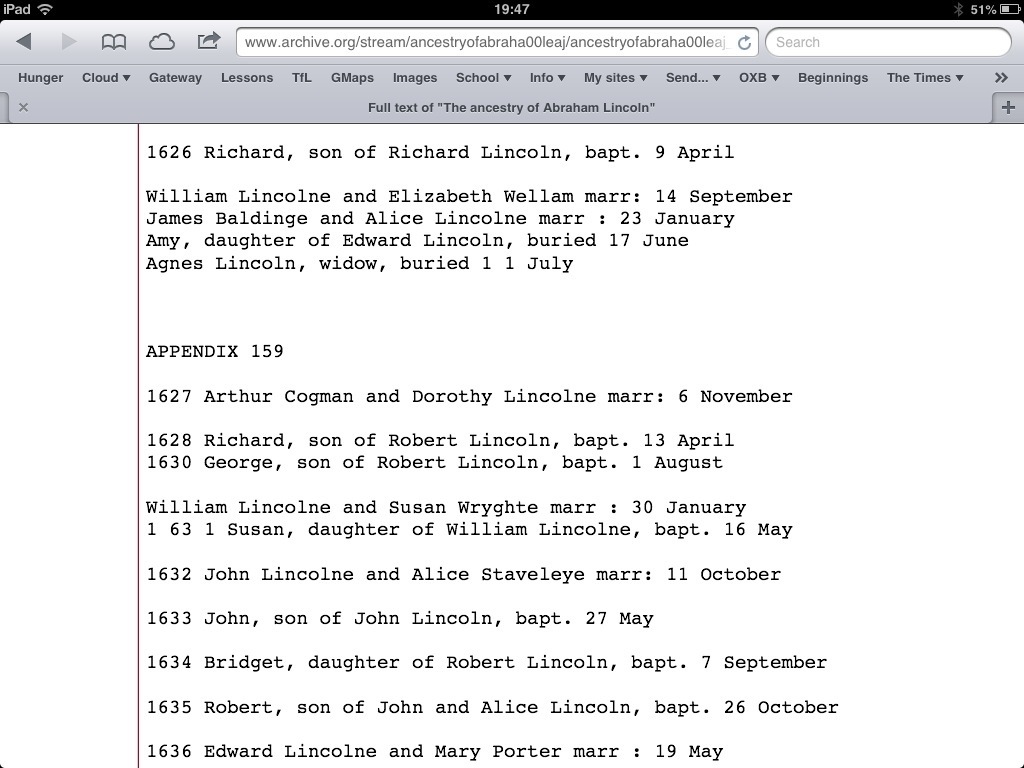
And it’s nice to see Hollywood finally acknowledge my kinsman: one of my father’s mother’s family (the Cogmans) emigrated in the 1600s and prudently married into Abe’s lot (vide 1627):

20130223-094907.jpg

Posted in Film | Tagged | Leave a comment

Oedipus at Colonus (King’s College production and subsequent rereading)

After seeing King’s College do this in Greek last week I thought I’d read this, for the first time in 30 years. Quite different from what I’d remembered, and from what I’d told the kids on the train, and, strangely, from what I’d picked up at the KCL production itself: as a play, much more dramatic, and in terms of plot much more focused on Thebes.

As I read the first few scenes I got that feeling I get nowadays reading parts of the Iliad that there’s more going on, that there are more layers of irony, of winking, than the bare text and its conventional interpretations suggest; by losing the gestures and inflections of performance, whether bardic or theatrical, we lose so hugely much. What I was suspecting was that Oedipus and his daughters were perpetrating a scam on Theseus, as Medea does to his father Aegeus, pretending to be refugees from Thebes, faking the threat from Creon, in order to get protection from Athens. I imagined a Trojan Horse / Sinon scenario, with little clues, like Ismene’s arrival on an “Aetnaean horse”: “horse” for Troy, and “Aetnaean” as a hint at Athens’ defeat in Sicily in 413. But once we get into the climactic three-actor bit between Oedipus, Creon and Theseus, Oedipus’ respect for and dependance on Theseus are clearly genuine and uncynical.

Once he’s got Theseus’ protection, proved by the king’s material intervention in rescuing his daughters, Sophocles does the usual dramatist’s trick of shifting our sympathies: until now we’d felt for the exiled and persecuted Oedipus, but from where Theseus Socratically introduces the arrival of Polyneices (“But I’d like your advice about something which just happened on my way here, a small matter, but puzzling”) we cringe at his excessive anger, as, in true tragic fool style, he curses his sons to mutual slaughter. The Chorus and Antigone both warn him against excessive θυμός, but fail to stop him. So far so clear, and parallel in its furious rejection of rhetoric to Achilleus in Book 9 of the Iliad, but Sophocles introduces to this archetype a new discussion of death: note what the Chorus say between Oedipus’ reluctant agreement to see Polyneices and the actual meeting where he curses his sons:

Not to be born at all
Is best, far best that can befall,
Next best, when born, with least delay
To trace the backward way.

In cursing his sons to an early death he is, according to this, conferring a blessing. And from here on the play is a meditation on death: Polyneices and Eteocles’ from their father’s curse, and then Oedipus’ own. The play is a famous posthumous prize-winner for Sophocles, and he was born in Colonus, so there has to be a large element of Tempest-style personal adieu. This is framed as a twist on the end of the Iliad: there, Priam asks for, receives, and buries Hektor’s body; here attempts to have the blessing on their soil of Oedipus’ tomb fail, as he’s removed bodily by the gods. [Though we are told that Oedipus’ death at this place will result in an Athenian defeat of the Thebans at Colonus.]
And the play ends, as the Iliad, with a let down from sublimity: as in the epic the Trojans set guards against a possible Achaean treacherous attack, so Oedipus’ daughters, in brilliantly conveyed loss and confusion, want to hurry to Thebes, in what we know to be a doomed attempt to prevent their brothers killing each other, and the consequent terrible events of Sophocles’ alleged first play, Antigone: things, depressingly, come full circle.

Posted in Play | Tagged , , , , | Leave a comment

“The Sense of an Ending” by Julian Barnes & “The Reader” by Bernard Schlink

Strange how things fit together by chance. I read these two back to back with no thought of connections. Both are short novels, novellas, intellectually “about” “history”, and written by male narrators each looking back over a relationship with a woman in his distant past. In both the narrator has been (unnecessarily, in my view: why can’t these character-types get over it?) messed up for the rest of his life. But of course they’re very different: the Barnesy girl is middle-class English, whose problem is just being a bit weird and having a sneering brother; the German girl is a convicted war-criminal. And the points of both novels couldn’t be more different: Julian’s is a Lolita-like exposé of a narrator (but Julian’s finds out what a dick he’s been), seen through the filter of a remembered schoolboy discussion on the nature of history and how forgettable and subjective it can be – hence the exposé when he realises how all his life he’d misinterpreted his own history. The book seems to be leading to the narrator’s suicide (or at least, if Julian wouldn’t be happy handling a post-mortem narrator), the attempt, but we don’t get there: things are more prosaic. Bernard’s is one of those German books contemplating the Nazis, and in particular the Holocaust, so is about history in another sense. I don’t think it says anything particularly interesting about this, but I’m not German. What is good is the way the image of the crime the woman is convicted of – not unlocking a burning church containing Jewish prisoners – serves to illustrate the perceived predicament of the German people. And what is best is the revelation, at the book’s end, of the woman’s 18 years in prison coming to terms with what she had done, before killing herself on the eve of release. Barnes, on the other hand, gives us merely the sense of an ending.

Posted in Novel | Tagged , | Leave a comment

“Minotaur” by Harrison Birtwhistle

Managed to see this revival – £13 ticket up high on the side – but enjoyed it much more than the first time: I was spellbound more or less from start to finish, by both the music and the spectacle – I think I now understand more what opera is really about. But that’s mainly I think because it’s Birtwhistle, because the music is a constant undercloth, or rather a rough mat over water, over the sea: the swelling and splashing pushing up through the surface texture; it’s NOT a series of songs like a 19th-century musical. The interscene projection of slow-motion waves is probably the reason why I saw the music this way, but let’s let the visuals suggest interpretations of the audio. And the story is about sea-travel. And the opera constantly plays on ideas welling up from the deep, from the Greeks, and from, vitally, inside Ariadne. For this is her story, not Theseus’, and not in fact that of her taurine half-brother. But it is about these two males, in that the bestial violence of the Minotaur in some ways conveys Ariadne’s awakening sexuality, stirred by the disruption of her literally insular life by this hunky foreign hero. The Minotaur rapes his victims before goring them to death, and himself is the twisted product of Ariadne’s mother’s unnatural lust for a bull. But, as Theseus’ foe, something he has to slay in the Labyrinth, he more significantly represents Ariadne’s resistance to him (or, indeed, therefore, Theseus‘ sexuality: this explains why the opera ends with the beast’s death – at this moment she is finally conquered). In the best tradition of who-really-makes-the-moves, it is Ariadne who wins Theseus, by using him to conquer her beast within: she encourages him, and gives him the ball of thread (in this production virginally-symbolically red) which he can use to come back after his descent to his girl’s unconscious. Ariadne uses Theseus to “do a Ged”: chase and slay the externalised part of herself which threatens her.

Posted in Opera | Tagged , , | Leave a comment

“Unholyland” by Aidan Andrew Dun

Another step on Aidan Andrew Dun’s journey towards the poetic recognition he so deserves, and perhaps a major milestone: he now has his name and words fixed in stone at King’s Cross, and has attracted, for the cover of this book, plaudits from Kate Kellaway and Andrew Motion. There’s also a major event in January at Housman’s bookshop in King’s Cross, which I sadly had to miss.

Aidan is a very special poet, who immediately made a huge impact on me when I came across him by chance at a reading in the Voice Box, where he jumped up like a rock star and performed the amazing beginning of Vale Royal. A few years later, Ode to a Postbox‘s appearance in the Guardian helped me find him again, and two visits to my school and obligatory reading of everything he produces have put me firmly in the fan club. He’s completely unique, always doing new things with verse, both at the technical level (witness the sonnets in this new piece) and with content: an epic poem about a valley in Central London, a rap love-story set in Israel/Palestine.

So what is it about him? For me his salient feature, apart from the originality, is his ability or willingness to combine things expressed in sublime, perfect, poetry, with things said in ways which seem at first bathetic. (As a teenager I was always impressed with Genesis songs which did this – the refusal to sacrifice meaning for form.) This juxtaposition of ‘high’ and ‘low’, if you like, is more perhaps a treatment of everything as ‘high’ (as the Quakers, who have abolished not the priesthood, but the laity). All forms of expression are eligible for poetry; and this carries across into content too: Unholyland is full of sharp jumps from rich, gorgeous descriptions of sunsets and love-making to the slang, lives and cars of street people. It’s in a way a Chaucerian feature: Aidan often reminds me of good old Geoffrey, particularly in this poem, when he’s talking direct to the reader, moralising or commenting on life, or when the words he chooses are self-consciously selected for the rhyme.

Indeed it’s the technical nature of the verse which interested me most as I read. Aidan uses Pushkin’s Onegin stanza: a sonnet form which rhymes ababccddeffegg. [As you’ll learn from Wikipedia, several other writers after Pushkin have used this form, including what seems like an incredible technical tour de force from John Fuller. (It’s always impressive when a poet uses a meter which originated in a different language, as Virgil with Homer’s hexameter.) Aidan doesn’t adhere as tightly: his a, c and e rhymes aren’t feminine, and his iambic tetrameter is usually a looser, simpler four-beat line.] This rhyme-scheme fascinated me: sometimes I tried to read each sonnet fully conscious of the rhymes, and found the first part, the ababccdd, smooth, even jangly – the two couplets ending this part of the scheme are easy rhymes to follow. But when, after e, we get the ff couplet, I got lost, finding it really hard to know where I was, metrically. Here’s an example, the first sonnet of Chapter Two, describing the hero, Moss (pronounced Mosh) preparing to go on a journey:

A silent engine ticking-over,
idling, transmission disengaged,
might be compared to time forever
hovering outside what is gauged
past, future, poised in the present;
suspended, high-powered, heaven-sent,
waiting in neutral for the word ‘go’
which never comes, or only comes slow,
when a long age has passed at low revs.
Moss sat waiting at the wheel
a good time, getting the track’s feel,
checking invisible semibreves
in the bass, lots of space:
Greedy Dog in a state of grace.

Particularly when, as often, there’s a major sense break (the volta?) after the first e line, reading through into the ff couplet is hard because I’m aware of an unresolved rhyme hanging around – it takes me a big effort to note the second e as the resolution to the first. The effect, for me, is either to read with less conscious tracking of the rhyme, or to expect, and enjoy, this threat of derailment I approach the sonnet’s end.

There’s a more thorough assessment by Poetry Scotland Reviews, from which I’d like to make two quotations:

This unlikely scenario is carried off by utter confidence. Vale Royal for all its flamboyant achievement was a teeny bit showy. In Unholyland, everything that needs saying – and a lot needs saying – is said simply and with confidence.

I’m not sure about Vale Royal‘s being “showy” though agree that Unholyland is less so…

The poem abounds in lines memorable in themselves. Balancing the felicitous narrative ease comes a sense that the poem was difficult to write but has been written successfully against the odds.

This is a better way of describing what I was talking about above: the juxtaposition of high and low. There’s a genuine sense of struggle in Aidan’s verse, coupled strangely with his huge confidence – his uniqueness.

Posted in Novel, Poem | Tagged , , , | 1 Comment