Monster; Everything Everywhere All at Once

Monster

Boys told they have a pig’s brain transplanted into their heads, which explains a) their poor behaviour and b) their effeminacy/homosexuality. Those are the monsters.

It’s got a wonderful ending, when you are supposed to think, I believe, that the two boys have died and have woken up in some kind of paradise version of our world – but you can’t be certain. It might just be a happy ending.

Everything Everywhere All at Once

For the third time. But for the first two I was asleep for most of it, so didn’t really have a clue. I remembered it as mad and incomprehensible, but from watching it ‘properly’ saw that it’s actually a pretty straightforward martial arts multiverse story – inasmuch as martial arts multiverse stories can be so.

But – and this is probably true of most martial arts multiverse stories, certainly of adventure stories (tLotR big-time) – it’s really about something much more homely and (dread word, my first casual usage) relatable. It’s a kind of dream sequence in which our protagonist works through her relationships with her husband and daughter. That’s it really, and it’s brilliant.

How they are related

Monsters are beings from magical adventure stories, so in that sense both films address perennial, real-world, family questions through an extension into the unreal magic/sci-fi.

Posted in Stuff | Leave a comment

Driving Madeleine; The Holdovers

Driving Madeleine

A modern-day Charon takes his victim/customer to the underworld; or, rather, a cabby drives an old woman across Paris from her apartment to an old people’s home. They strike up a deep friendship, ending with the woman – who dies that night – bequeathing the money the cabby needs to help his family.

The Holdovers

A modern-day Scrooge is forced to look after an unpleasantly unhappy young man over Christmas. They strike up a deep friendship.

A superannuated classics teacher ends up being eased out of his job.

How they are related

Both describe an arc of personal relations moving from tension to warmth and affection. They’re also both about affirming family life.

Posted in Stuff | Leave a comment

The Iron Claw; Wonka

The Iron Claw

The true story of the Von Erichs – a 1980s US wrestling family. The father, a star wrestler who never got the world title, pushes his five sons to get the title for the family – with inevitably tragic consequences, including two deaths and a lost foot. I was reminded of the family of Ludwig Wittgenstein: three of his brothers died by suicide, partly as a result of their father’s obsession with them continuing the family’s steel business.

My third Curzon film with Jeremy Allen White (with Fremont and Fingernails).

Wonka

Another business… This is basically a founding-myth story about how Willy Wonka got to be running the amazing magical chocolate factory in that other Ronald Dahl story. And it does the job well, with amazing visuals, cheesy musical songs, a great cast of ‘Oh that’s wossisname from x’ moments, and some decent satire of evil cartel-ery. Three faces from Ghosts, the nice English teacher from Sex Education who believes in Maeve, Sally Hawkins, Matt Lucas, the nice old chap from Shakespeare in Love – they’re all in it. And apparently the lead – Timothée Chalamet – is also well known (even I’d seen his face in posters for Dune 2).

How they are related

Both are about business, about working hard to achieve business success, and about family.

Posted in Stuff | Tagged , , , | Leave a comment

The Zone Of Interest; American Fiction

The Zone of Interest

Read about it yourself – anything I say will not do it justice. For a sense of the depth of thought and preparation behind this film have a look at this from Wikipedia:

Glazer did not want the atrocities occurring inside the camp to be seen, only heard. He described the film’s sound as “the other film” and “arguably, the film”. To that end, sound designer Johnnie Burn compiled a 600-page document containing relevant events at Auschwitz, testimonies from witnesses, and a large map of the camp so that the distance and echoes of the sounds could be properly determined. He spent a year building a sound library before filming began, which included sounds of manufacturing machinery, crematoria, furnaces, boots, period-accurate gunfire and human sounds of pain. He continued building the library well into the shoot and post-production. Most of Mica Levi’s score went unused, as Glazer and Burn did not want to have the film “sweetened or dramatized” by it. The music Levi wrote for the prologue remained, as did soundscapes created for several sequences and a sound collage for the epilogue.

So it’s a kind of irony, a misdirection, making us see something by showing us something else. In Aidan Andrew Dun’s phrase, looking ‘to either side of what is seen’. And the purpose is to make us see the truth better through this misdirection; the film’s final scenes suggest that we have become immune to Holocaust-museumification, -heritagisation – so a new approach is needed. But the genius of the ending is that in those final shots Höss seems to be magically granted a vision of the future, of the stinking pile of evil which is his direct legacy. And he is physically ill at the sight, but then deliberately descends silently into the darkness to continue his work.

American Fiction

A very clever parody of white people’s attitudes to racial guilt. So it’s a film of ideas, particularly – in what I found the best scene – when three white literary judges end up voting down two Black judges, in favour of the spoof ‘Black’ novel written by our hero (who is secretly one of the judges). ‘It’s so important to listen to Black voices’ is the conclusion of one of the white judges. The hero’s back story is strong too, a narrative which nicely supports the primary intellectual element.

How they are related

Two ways of addressing racism, but so so different: one a comedy, one something quite new. And two different kinds of racism – in fact it seems wrong to call what happened at Auschwitz ‘just’ racism – again that was something new.

Posted in Stuff | Tagged , , | Leave a comment

Trenque Lauquen; The End We Start From

Trenque Lauquen

(Literally ‘Round Lake’ – a town near Buenos Aires.)

An Argentinian film in two parts, totalling over four hours. Quiet, mysterious, and disconcerting: I often felt, particularly in Part I, as I did when watching Tarkovsky’s Stalker, or (less directly) reading something by W.G. Sebald. Part II, with the arrival in the town lake of a strange being – child or beast – is a little more like Arrival or Annihilation, though its theremin soundtrack reminded me of Asteroid City.

I guess in short it’s a long film where nothing happens, but that’s not to say that things don’t threaten to happen. There are people interacting, forming relationships, and conventional enough plotlines which emerge and develop, but which then tend to peter out and morph into others. If there’s anything deliberate in this story (which took six years to produce) it’s a wilful refusal to complete narrative. And it works.

The End We Start From

This film, on the other hand, simply reeks of story arc: in brief, a couple have a baby, are separated by a climate emergency, and finally reunited.

Two things make it great: Jodie Comer’s performance, and the whole what-Britain-might-be-like-in-such-a-crisis mise-en-scène, with dire news reports, the army running refugee camps, and ordinary citizens trampling each other to death to get food parcels. And Gina McKee.

Jodie finally gets to a commune on a Scottish island, seemingly led by Gina. Then she has a swim in the sea, shouts a bit, and decides to go back to the mainland because she doesn’t want her child to grow up knowing her mother had run away (or similar). Me and my mate thought this volta was not done very plausibly, but the other who tempered our negative view of Priscilla in similar vein persuaded me it was OK.

How they are related

(Other than in their being opposites in adherence to plot norms.)

Two women protagonists showing grit and perseverance in unfamiliar and dangerous circumstances. Both women determinedly pursue their stories, and disappear: Laura on purpose from her known world, Jodie’s character by circumstance, hiding on the island. The difference is the narratological one: Jodie comes back, Laura’s plot path just sort of fades out, gets lost in the marshes.

Posted in Stuff | Tagged , , , , , | Leave a comment

All Of Us Strangers; Samsara

All Of Us Strangers

What’s weird about my reception of this film is that it’s a heartbreakingly sad portrayal of and meditation on loneliness, but I – who weeps in cinemas if someone smiles in a sad way – was tearless throughout. Why? Perhaps because I didn’t realise that it was said portrayal of and meditation on until afterwards… And then it was just too late.

Lots online about what actually was going on. It seems clear that Adam’s initial rejection of Harry led to Harry’s death, and so the whole affair was, like Adam’s meetings with his parents, imagined.

We are all of us strangers, and the film seems to suggest that we remain so because we drive others away. But does the ending suggest that this isn’t actually a problem? Frankie’s The Power of Love, and Adam and Harry’s warm spooning might be telling us that imagination is all we have, and it’s OK.

Samsara

Well, I didn’t actually see all of this, walking into the wrong screen, and getting angrier as what I thought was the start time came and went, and then nipping out quick as the certificate All Of Us Strangers flashed up. Whoops. So I arrived some 30 minutes late.

In the first half – Buddhist monks in Laos – an old woman is helped through her death by prayers and readings from the Tibetan Book of the Dead. Then there’s 20 mins of darkness / different coloured screens with music and sounds. And then film about a Muslim family on the coast of Zanzibar in Tanzania. A new goat is born, who then gets lost.

A friend told me last night that the word Samsara refers to the cycle of life, so the goat is the old woman reincarnated. The central section is her soul’s journey between in carnations, through the ‘bardo’ as described in the Tibetan Book of the Dead. I should have realised that… perhaps in a future life I’ll be less obtuse.

[Have now watched the beginning, and, yes, friend was right. There’s mention of a golden deer living behind a waterfall which got killed in a a flood; which foreshadows the goat’s imminent death from flooding at the end of the film.]

How they are related

There’s lots going on in the imaginary space where these two films are mates. Both depict a solitary soul making a journey, and address the nature of death. Both are also, despite appearances, positive (I feel). In Samsara the soul prepares itself for the journey, and is as far as we can tell ready; whereas in Strangers Adam’s soul isn’t in any kind of state of preparation, but just passively experiences. We, likewise, don’t realise what’s happening, or happened, until then end. But at that point we are made to contemplate what Adam’s lonely soul has done, and what – arguably – it has achieved.

Posted in Film | Tagged , , , , | Leave a comment

Paris, Texas; Poor Things

(What lovely alliteration.)

Paris, Texas

A man walking, walking, walking. When he collapses, a doctor finds his home address in a pocket and contacts his brother, who comes to take him back home. So it’s the Odyssey, with his brother acting as Telemachus. But when he gets home, he’s as in Scrapper, as his son never knew his dad but now has to come to terms with him. Which he does, and they go looking for the man’s wife…

Poor Things

A Frankensteinian feast of steampunk, spawning feminist questions about whether showing a woman really enjoying sex is liberatory or oppressive.

Easier to compare with Saltburn – an over-the-top Gothic fantasy whose Gormenghastian protagonists’ arcs rise to take over the castle, or whatever.

How they are related

Alliteration aside, the connection must be the two brothels – one where the hero’s wife is discovered making her living, the other where Emma Stone becomes (financially) independent of Mark Ruffalo. The Paris, Texas one is weird (at least as far as my limited experience can tell) in that each room is dressed up as a different kind of room where the punters can get the women to act out their particular fantasies. Whereas the Poor Things one is just a rough and ready Parisian knocking shop (with, btw, a wonderfully wise old madam). It’s the non-brothel sets of Poor Things which form a parallel to the little rooms in the Paris, Texas brothel – huge and dripping with every luxury and elaborate decoration, vast skies of shifting colours and patterns, vistas and backdrops to the journey of sexual discovery undertaken by our heroine…

Posted in Film | Tagged , | Leave a comment

The Animals In That Country; The Normal Heart

The Animals In That Country

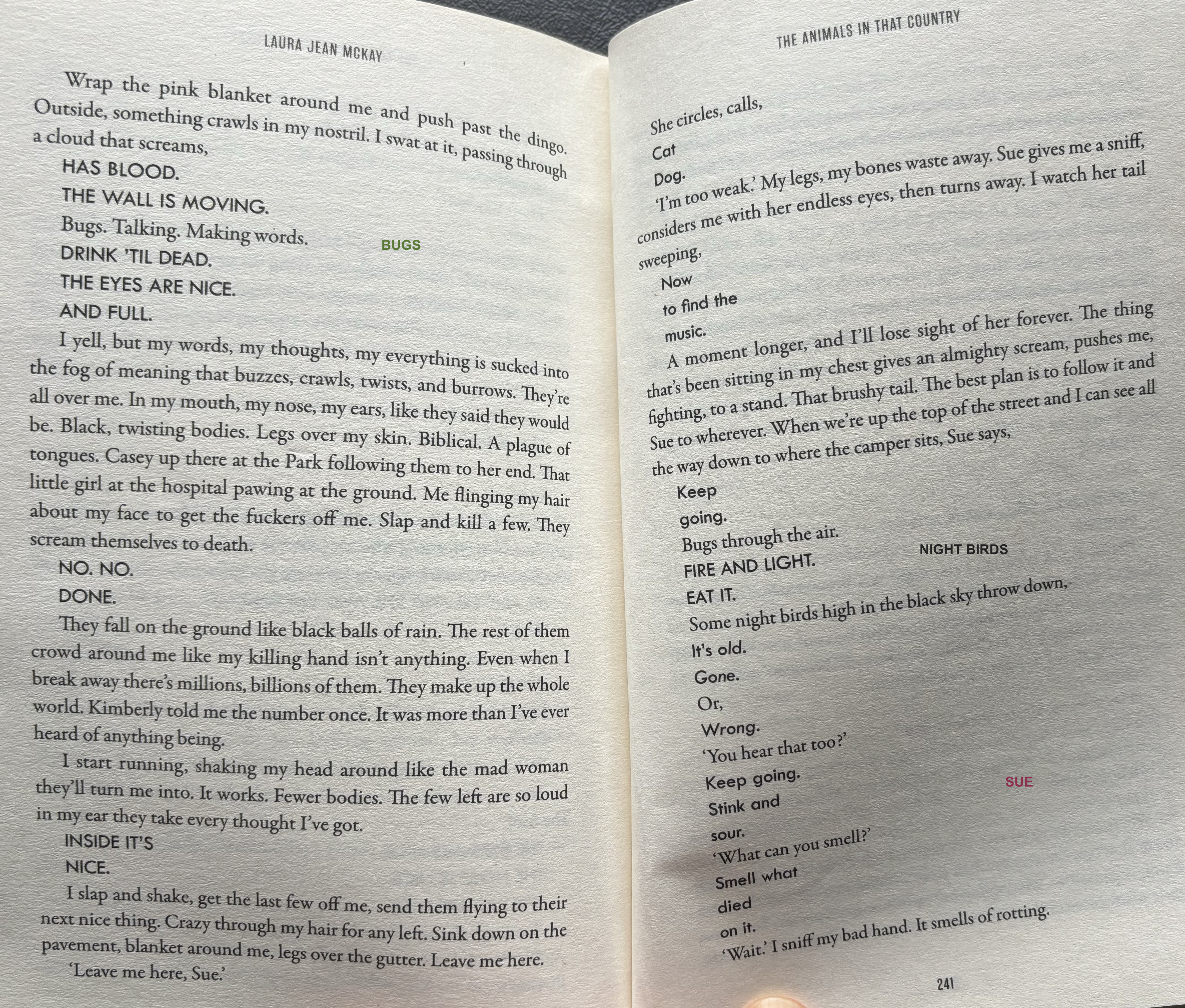
A 2020 novel by Laura Jean McKay. It’s in the voice of Jean, a middle-aged woman who works at a wildlife park in Australia. A zoonotic pandemic enables people to communicate with other species.

What’s really interesting about this is that when we see what the animals say (set out in a different font, as poetry), it’s very hard to understand. It’s the first time I’ve understood what Wittgenstein meant by his ‘If a lion could speak, we could not understand him’: I mean it’s in English, right? But the world of the other species has such different concepts and conventions that even when ‘Englished’ it’s often unfathomable. I found this frustrating when reading the novel, as (I guess) I’d been looking forward to seeing what animals actually thought, forgetting first that it’s a novel and second Wittgenstein’s warning.

The sample below manages to include the utterances of several (labelled) species – which is rare, as the vast majority of animal-talk is Sue the dingo): dog (the dingo Sue); bugs (they are terrifying); and ‘night birds’.

The Normal Heart

A 1985 play by Larry Kramer, written – before either of the terms ‘HIV’ or ‘AIDS’ had been coined – as a wake-up call to the world about the new disease killing gay men in New York. The production was at the ADC in Cambridge, directed by {disclaimer} our nephew Alex Velody.

How they are related

The obvious connection is the arrival of surprising new diseases which turn everything upside-down. Both situations are also about the failure of communication, due to a dominant group’s writing off of the less powerful one (humans: animals; straights: gays). The trajectories differ, however, as humans manage to shut off the animal chatter, but the voices of gay men are not cut off, but get more and more mainstream.

Posted in Stuff | Leave a comment

Welcome to Houyhnhnm

Named originally as an antidote to Yahoo (both are rival creatures in Gulliver’s Travels), Houyhnhnm has for a while been a prompt to myself to make comparisons between the last two things I’ve seen/watched/read. I hope you enjoy my at times torturous attempts to wrest meaning from two unrelated pieces. Mega SPOILER ALERT – I assume you’ve seen or read whatever I’m writing about, as I am my own target audience.

Posted in Stuff | Leave a comment

Sweet Sue; Priscilla

Sweet Sue

(Btw no Wikipedia page yet; cripes. Only this about an old play – a version of the Phaedra myth – which might actually have been at least some inspiration for this film.)

One of those lovely poignant comedies at which arty cinema so excels: see Fremont, Fallen Leaves et al. This one’s great: lonely middle-aged woman hooks up with a biker called Ron she meets at her brother’s funeral. Ron’s son, Anthony (with a θ) is a hugely camp and glam dancer and influencer, whom we meet in very funny scenes with his sugar daddy. Things go wrong when some laughing happens – see below.

The film’s about how much hurt can be caused by laughing at other people. The first scene has Sue in her party shop looking miserable, while two shoppers are in hysterics mucking around with masks and balloons; they’re not quite laughing at Sue but it feels like it. At a later dinner Sue and Anthony upset Ron by laughing at him, and then it’s Anthony’s turn to be a laughter-victim when Sue watches him rehearse his dance moves and can’t control the giggles.

Anthony then changes his social-media portrayal of his new step-mum from ‘wow isn’t she cool’ to a ‘she is the most manipulative person in the history of the universe’ vibe; a rather unconvincing volte-face imho but necessary for the plot.

All ends well, however, when Sue comforts Anthony after he has a tiff with his sugar daddy, and all ends reasonably well – though, as one reviewer commented, it’s not fully resolved and we imagine the tensions in these relationships are going to continue in similar vein.

So in some ways it’s comedy at the expense of emotionally-challenged people.

Priscilla

(I didn’t like this; perhaps the worst of all the many films I’ve seen since the summer. Sorry Priscilla and Sofia.) [News just in: friends liked it, and have persuaded me it wasn’t as bad as my initial reactions. It all depends – as with Saltburn – on how self-aware one feels the film is… Irony has to be perceptible.]

This reminded me in its limitations of Rocket Man, which was clearly (just) Elton’s version of his story. Here is Priscilla’s chance to give her side of her relationship with Elvis, but unlike Elton, and unfortunately, she included for obvious reasons hardly any musical performances. The first half of the film is effective, albeit in a creepy way, as Priscilla shows/claims how Elvis basically groomed a naïve 15-year-old to become his girlfriend, and then kept her a virtual prisoner back at Graceland to ‘keep the home fires burning’, while he had affairs, including with his co-leads in his movies [though we’re never quite sure if these affairs were little more than publicity stunts to keep him in the magazines and tabloids].

Elvis’s world is effectively portrayed as Priscilla would have seen, and did see, it. An example is the gang of goofy mates which always surrounds him: a source of comfort for the insecure Elvis, but for Priscilla a barrier which keeps her from getting to know her partner properly.

How they are related

Two unhappy women. Both get involved in happy romances which go wrong. Beyond that they’re not really very similar at all: Sue is in no way controlled in the way Priscilla is; in fact she dominates her relationship with the subservient and strangely taciturn Ron. But it’s the endings which, as so often, show the difference in quality between the films. Priscilla tried to end neatly with her walking out of the relationship to Dolly Parton’s I will always love you, but there’s no indication of what will happen to their child, or how either of them feel about it. And it’s corny as hell. Sue, on the other hand, ends with her relationship with Ron over (I think), but her reconciliation with Anthony shows a nuanced approach to the story might develop from here. Their lives continue.
Posted in Film | Tagged , | Leave a comment