“Sweet Tooth” by Ian McEwan

So far my McEwan reading has been:
The Comfort of Strangers (many years ago, at a friend’s house). A chilling novella with a gruesomely violent ending, but whose motivations are implausible
Saturday. Again tension, but this time much better handled as it so nearly bursts out as before, but the dénouement, based on the Power of Litratchah to Tame the Violent, sets alarm bells a-tingling
On Chesil Beach. Different – the tension coming from within a love story, without the latent violence of the earlier two. Bursts well(!)
Solar. The least successful, imho; a sub-Frayn ecofarce.

And now Sweet Tooth. As before, McEwan bases the read on tension, but this time within a genre where that’s expected – the spy thriller. The big twist at the end is exceptionally clever and brilliant – one of those endings that almost takes your breath away, leaves you physically reeling for a while. (The nearest comparison I can remember is Marilyn French’s The Women’s Room.) But it’s not a spy thriller ending: the book’s weakness for me was in promising a spy book but delivering a love story meshed in (again) with Litratchah: literature about the writing of literature is inevitably a disappointment (unless it’s by an Ancient Greek or Roman, natch #theOdyssey). Too many festivals and creative writing courses.
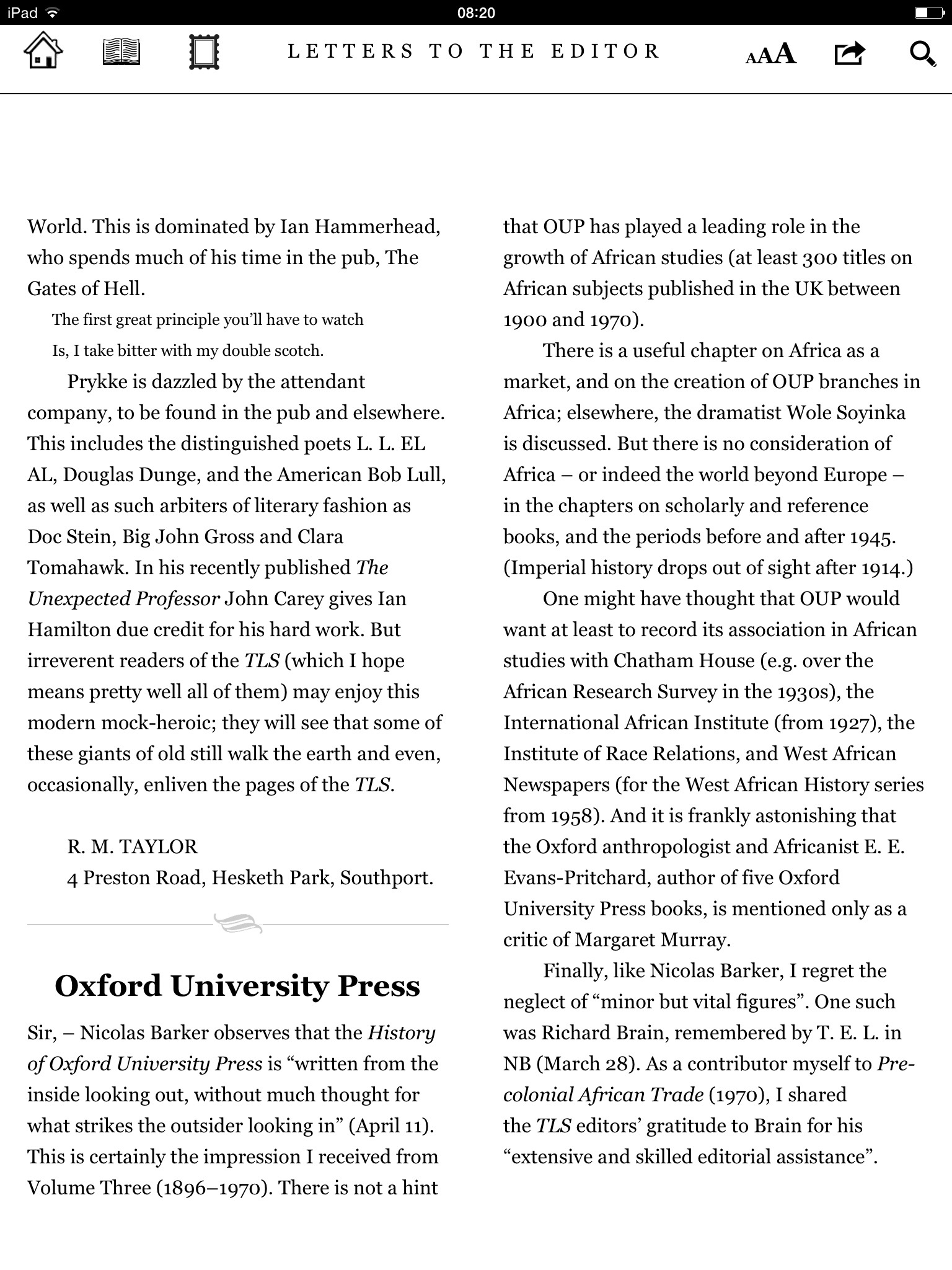
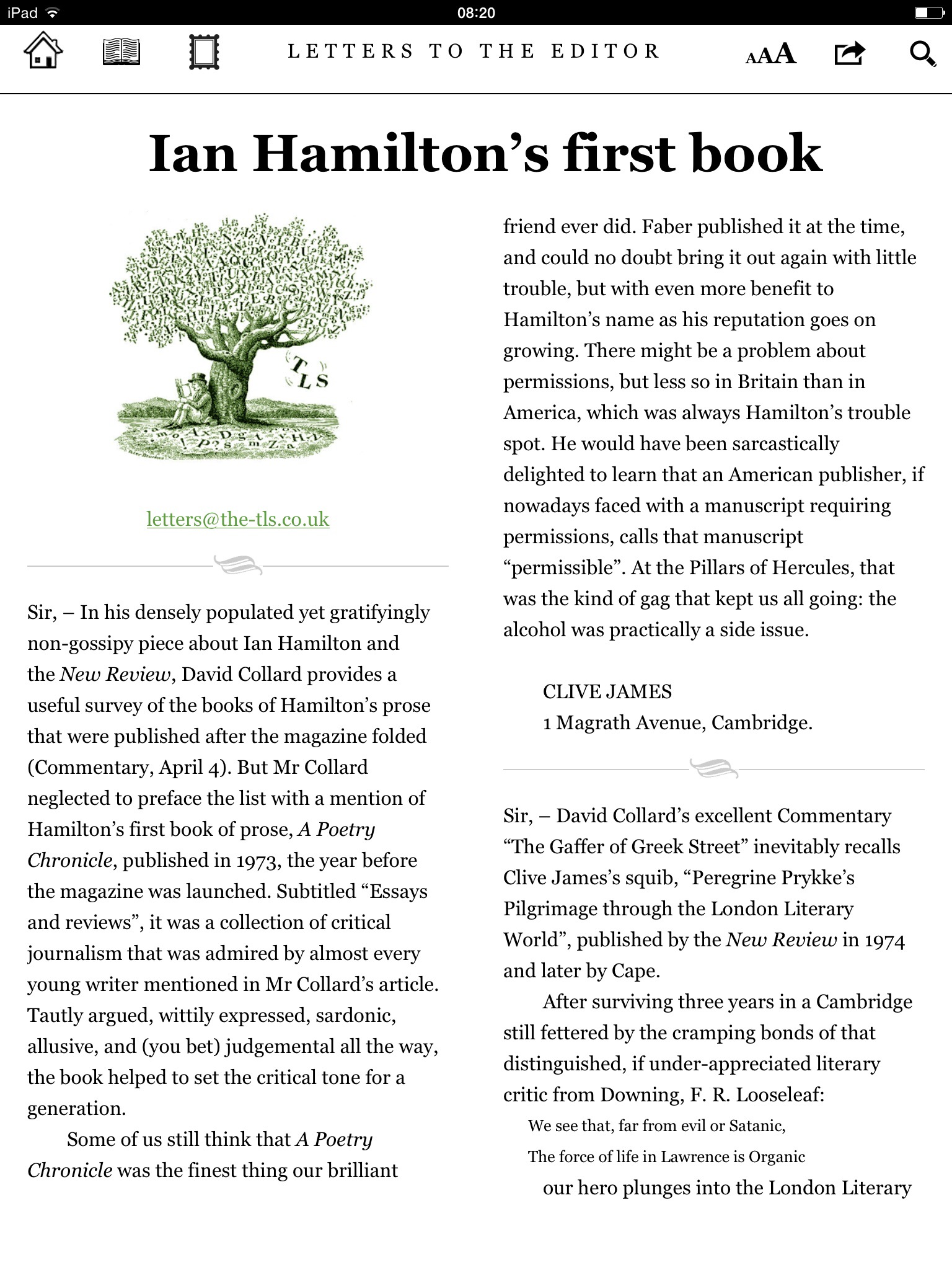
One of McEwan’s main aims is to recreate the heady atmosphere of early-70s 3-day-week Cold-War literary London. Mart appears, Angus Wilson gets a namecheck, and I learnt about Ian Hamilton and his sessions at the Pillars of Hercules – see screenshots for more.

20140418-113828.jpg

20140418-113838.jpg

Posted in Novel | Tagged , | Leave a comment

“Homecoming” by Michael Morpurgo

A moving tale by the great man about his own childhood in Bradwell, Essex, and how the building of a nuclear power station destroyed a paradise, in particular the caravan-home of Miss Pettigrew. Much is made of the fact that only a few decades later the power station is being closed down. What was it all for?

Michael Morpurgo is a patron of the Othona Community, whose original centre is next to St Peter’s Chapel Bradwell, the oldest church in England.

Posted in Reading | Tagged , , | Leave a comment

Plato’s Symposium

As often with Plato there’s a layered entry: the party being related is remembered at second hand. This is important as it sets up doubt, makes us wonder what’s really going on here.
The game the men decide to play is to each in turn give a speech in praise of love.
Phaedrus: love is very ancient and important, as it’s the best motive for noble and heroic action. No one runs away in sight of their lover. Achilles and Patroclus, pace Aeschylus, weren’t lovers.
Pausanias: two Aphrodites: one common, one noble. The noble one is the proper εραστης/ερωμένος relationship. No activity is all bad or all good – it’s how it’s done which counts.
Eryximachus: love can be applied to all aspects of life, e.g. medicine, and is what maintains a healthy balance between extremes. It’s a kind of harmony.
Aristophanes: love is the essential task of seeking our original “other half“, or close alternative, and reuniting with that person. Much comedy in the ridiculous way he tries to explain the anatomy of these combined people.
Agathon: important in a panegyrics to state the subject’s properties, and then their effects. Love is kind, peaceful, sensitive, and makes the whole cosmos like this, including inspiring all artistic activity.
Socrates: sarcastically points out that he didn’t realise that the rules were not to tell the truth, but make a fancy speech ascribing to the subject if the panegyric all the good qualities one can think of. He then insists on doing it ‘his way’, and reduces Agathon to blabbering that he didn’t know what he was talking about earlier (as love of something implies that the lover lacks the something; love therefore can’t be itself beautiful and desire the beautiful).
He then relates Diotima’s Socratising of himself, patiently pointing out that what people (and animals) in fact love is immortality. She then goes on to the hard bit, the ‘perfect revelation’, whereby men’s love for beautiful men leads them to all beautiful objects, to beautiful thoughts and sciences, and finally to το καλον, beauty itself, the form of beauty. She ends with fusing these two strands, arguing briefly that if a man loves beauty itself he will be loved by God, and therefore immortal himself.
Then chaos, as drunkards break in, led by Alcibiades. It’s very funny, and eventually Alcibiades gives a speech in praise of Socrates himself, how he has successively tried and failed to seduce him, and how his words, valiant actions in battle, and total self-discipline have affected him.
Then chaos, as more drunks take over, this time ending the civilised speeches. In the morning only Socrates, Aristophanes and Alcibiades are left awake, and at the end of the dialogue only Socrates.

So what to make of it all?

There’s lots of comedy, more than usual for Plato. It comes partly from the banter of the party, but also interestingly from the undermining of the earlier speeches. Socrates deftly takes Agathon apart, and, by extension, the other speakers. And by using a woman, Diotima, as his primary authority on love, he is cancelling Pausanias’ assumption that women are baser, less intelligent. Further undermining can be found in the way Diotima in her speech, and Socrates in Alcibiades’, both knock away the foundations of the symposium itself, the Athenian male pederastically-banterous drinking party. Men-only, pederasty, drinking – all fall foul of Socrates’ arguments.

Posted in Philosophy | Tagged , , , | Leave a comment

“Notes in Advance” by William Glock

Born in 1908, William Glock became one of the most important and powerful people in British music[^1] in the second half of the 20th century. This autobiography was published in 1991; he died in 2000.
In summary:
– Christ’s Hospital & Cambridge
– Music critic for the Observer[^2]
– Post-War tour of Europe for the BBC’s Third Programme
– Founder of a music summer school, first at Bryanston in Dorset and then, famously, at Dartington in Devon
– Controller of Music[^3] at the BBC, including revitalising the Proms
– Running the Bath Festival
– All the above while playing the piano to professional standard, and socialising, often over a decent lunch or dinner, with the great and good of the musical world

My brief when reading this book was to see what I thought about Glock the man. It’s a strange autobiography, starting, as similarly did this blog entry, with the crushingly clichéd “I was born, the first of three children, in 1908 at Catford in south-east London”[^4], and yet containing more or less nothing about his personal life, his moral, religious or political thoughts, or his non-musical activities. This is deliberate – as he writes in the “Coda” (p196):

Only one thing was certain, It [the proposed autobiography] would be a study not in self-analysis, but of sixty years spent, first as a student and then, through many helpful circumstances, in doing my best to advance both public interest in music and its more intense understanding by those devoted to it. I suppose I took it for granted that, in recounting all this, my attitude and beliefs would show through.

He gives himself one chapter off, as it were (“Family Interlude”) in which he talks about the early death of his daughter; this is very moving, but in a Remains of the Day way: after quoting letters from her, and describing the medical details, he ends with the painful (and whimsically self-observing)

Oriel died at the age of thirty-four on 14 April 1980, and from such a loss one seems never to recover.

At other points he drops in the name of a wife or two, or the fact that he’s now called “Sir”. But no more. A friend recently called him “desiccated”.

His career, and alleged desiccation, seems to stem partly from his outstanding ability to initiate and lead, to ‘get things done’, and partly from his sense of musical mission. Glock was a forceful, energetic and successful start-up and shake-up man, head-hunted by institution after institution, and his mission, more than just an almost religious devotion to music (see above), was fired and focused by the failure of the English musical establishment to see beyond their insular perspective. As a young man, Vaughan-Williams and others advised him not to go to Germany to study with Schnabel, as he could learn all he needed in Britain. His insistence on going, and the excitement generated by what he learnt there, gave him the sense of quasi-moral outrage to fight the good fight for foreign and avant garde composers. With a mission like this, he could do nothing but concentrate his autobiography on music and musicians: anything personal would get in the way, the vessel of light must be transparent.

[^1]: By which I mean, in that strange phrase, “serious” music – “classical” in ordinary language.

[^2]: Sacked for being too into avant-garde, continental, composers.

[^3]: See note 1.

[^4]: Cf. the start of Gulliver’s Travels: “My father had a small estate in Nottinghamshire: I was the third of five sons.”
Posted in Biography | Tagged , | Leave a comment

Tellus, issue 5

Another of Ailsa Hunt’s excellent series of pamphlets publishing poetry about or inspired by the classical world. This contains some gems, in particular an excerpt from Timothy Chappell’s verbally-powerful translation of Aeschylus’ Agamemnon (“and so the house receives back its finished king”), some rather racy contributions (“Whitby” and “More Shapes Than Thetis”), and some great translations of Horace, Homer and Pindar; I particularly liked the updated wine-types in Matthew Landrum’s rhyming version of Horace Odes 1.20:

I laid up wine for your next visit. We’ll forgo
Chianti, Burgundy, Loire, Alsace, Bordeaux,

Napa Valley – we’ll drink nothing trans-Atlantic.
We’ll stick to the Sabine special organic…

Posted in Stuff | Leave a comment

“Deep Field” by Philip Gross

[See update, below]

Philip Gross’ contribution to a Quaker discussion on ‘non—theism’ is amazing: he speaks fast, weaving his own poems into what he says (sometimes breaking into one with no pause), and succeeds in deepening any listener’s thoughts about that word ‘God’ – there’s an unusual and strong sense of real wrestling with big, personal questions, wrestling both to understand as well as to attempt to express that understanding. So it was with joy that I found two volumes of his poetry at the Woodbrooke Study Centre; I bought the earlier of the two.
Deep Field is a sequence of poems about Gross’ father’s progressive deafness and aphasia (the inability to speak). The subject matter and the poetic material are powerful and moving, and particularly in the first poem (“Scry”) I was reminded of the sound of Gross’ voice from the Quaker discussion. After a first excited and delighted read I returned to the book a few weeks later and picked up where I’d left off, and couldn’t continue to the end. At first I imagined it was the form and layout (many of the poems are medium-length segments of larger series, it’s all free verse, with some of the meaning conveyed by how the words are set out on the page with indents and unconventional spacing), but then realised it was probably that what was being said didn’t seem (at least to my impatient eyes) to be changing or developing. The same images and ideas kept circulating – silence, language, the sea. Perhaps these poems take more time and effort from the reader than I can currently offer them – certainly the family circumstances described by Gross do.

[Update, 19/4/2014
Just read Carol Rumens’ review of Gross’ Later[^1], and she does a much better, and more positive, job of describing Gross’ style:

The stepped irregular, spreading forms of Gross’s late style ensure moments of searching and doubt are part of the texture

That’s it – thanks.]

[^1]: Poetry Review, Volume 104:1 Spring 2014 p114f

Posted in Poetry | Tagged , | Leave a comment

“Philip of Macedon” by George Cawkwell

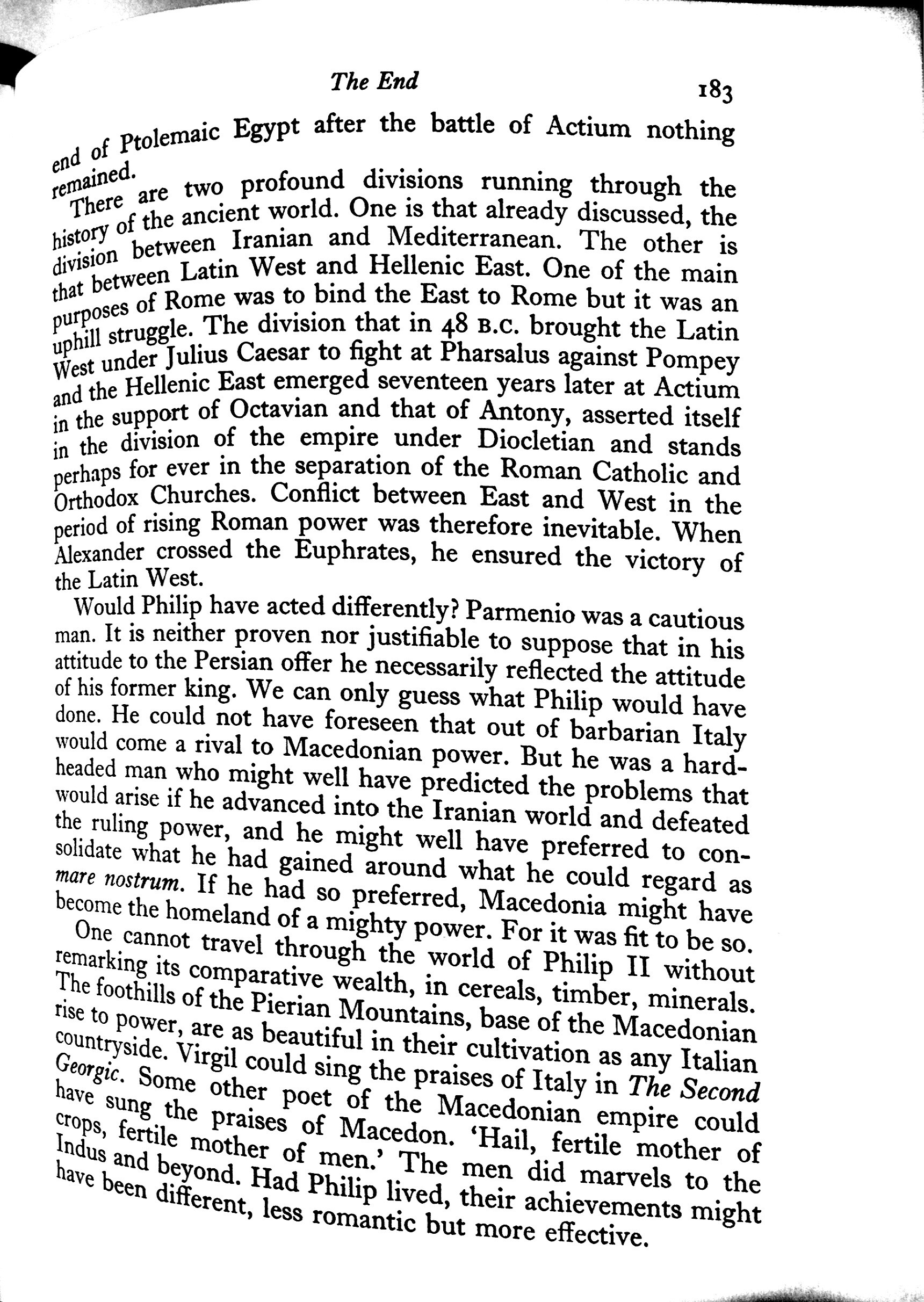
A standard—looking textbook, first published in 1978. I didn’t read it all, just plundered it for background after reading The Fire from Heaven; this showed how close Mary Renault’s account was to the sources (almost diminishing her imagination). I particularly enjoyed reading Cawkwell’s accounts of the Battle of Chaeronea, and of Philip’s assassination.
But the best bit, and worth anyone taking a look, is the final section, considering alternative histories: what if Philip had lived? Would he have, unlike his son, accepted the Great King’s offer of splitting territories at the Euphrates? If he had, would a Rome have been able to confront and defeat a unified Macedonian Empire wrapped round the eastern end of the Mediterranean?
And, if Philip had died when he in fact did, but had Alexander lived longer, would he have carried out his plan to Hellenise the south coast of Iran, and perhaps even the north—east coast of Africa?

20140413-211802.jpg

Posted in History | Tagged , , , , | Leave a comment

“The Fire from Heaven” by Mary Renault

From the start I was hooked, in a way: beautifully, intricately written, researched, and imagined, so at every turn I felt in the hands of a writer of the very top class. I knew she would be taking me on a deliberate, duff—note—free journey. But I was hooked only ‘in a way’: hers was a style I could not cope with in termtime: a few pages, even paragraphs, snatched in the minutes before sleep were not enough to maintain the storyline in my weak head; and this was made harder by Renault’s frequent tactic of withholding pieces of the jigsaw until later — you’re not supposed to know what’s going on for a page or two.
But that was my problem, not the book’s. Once the holidays kicked in I away, loving every moment, from the young boy Alexander’s running to his mother with the snake at the start, ‘meeting’ characters from the wider Greek world like Aristotle and Demosthenes, and the wonderful set—piece of the Battle of Chaeronea, to the slow build towards Philip’s assassination. [But I still couldn’t remember his assassin’s grievance- but that’s not unusual for me.]

Posted in Novel | Tagged , | 1 Comment

“Diamond Street” by Rachel Lichtenstein

An excellent London book, focusing on Hatton Garden, but ranging pretty widely around, and combining the author’s personal reminiscences with deep research. You learn a lot from this book, painlessly. It’s pushed me now several times to the area, listening to the roaring Fleet beneath a grating (see below), looking at what’s left of the diamond trade, revisiting the remains of the Palace of the Bishops of Ely on Ely Place, and (a particular highlight) attending (if that’s the right word) the 2013 Sagra, or Italian festival – already in the diary for 20th July this year: it’s a wonderful event – loads of people, pasta, street stalls, and a parade on floats.
Her last chapter is an account of how she persuaded Thames Water to let her down into the waters of the River Fleet itself – a psychogeographical delight.

{Just notes and thoughts}
Realising that this area was always going to rough, and appealing to immigrants, as it was just outside the city.

Realising that Jews and other displaced peoples would have been drawn to the diamond trade because it can all be transported easily and secretly.

Caledonian Road named after the Caledonian Asylum on Hatton Garden, founded for 120 Scottish Napoleonic-Wars orphans, and then relocated.

St Andrew’s Church was once on a hill… – the surrounding ground has risen so much.

You can see and hear the Fleet through a grating in Ray Street outside the Coach and Horses.

Obvious but unobvious: multi-exited roundabouts were important places: Holborn Circus / Ely Palace; Seven Dials was an abbey and leper colony

Wren’s biggest octagonal piazza would have stretched from Holborn Circus to Blackfriars, with Temple Church in the middle (see speculative diagram).

Wren's quadrangle?

Wren’s quadrangle?

Posted in History | Tagged , , , | Leave a comment

“The Big Over Easy” by Jasper Fforde

A clever, funny and surreal whodunnit, part of a series of novels; in fact after I’d finished reading it I found out that in an earlier novel one of his characters decided to lie low for a while by hiding out in an “unpublishable novel”: this one (he’d had earlier versions rejected by publishers). But I was unaware of this, because, obviously, this character was in hiding.

Humpty Dumpty is found dead at the foot of a wall… DI Jack Spratt, of the Nursery Crime Division (echoes of Genesis in the name) of Reading Police, is assigned the inquiry, and it goes on from there. Fforde creates an incredibly complex world, ontologically, and how and whether it works particularly interests me: it’s ordinary Reading, but with characters from fairy tales and detective fiction alive and real. Humpty’s death is the novel’s crime to solve, and a suspect’s wife is Rapunzel, who’d been having an affair with the serial philandering egg. Fforde seems to be in some ontological soup: firstly, the stories from which his characters come do seem to be known in the world – in which case their actions are fated, and  Spratt could just read about their crimes in advance. Also, the fairy-tale characters seem to be more-or-less limited to performing the actions in the stories, so, once they’ve all acted out the stories, there’s nothing left – the Nursery Crimes Division would exist for a short burst of fictional felony, and then nothing. In the climactic fight between Spratt and a monster engineered by a mad GM scientist (I shan’t reveal how she revealed) the situation is saved by Jack’s climbing of a beanstalk, who comments to his sidekick that in the NCD things seem to come together, that apparently disparate elements of the case seem to fit at the end, making a satisfactory narrative end. But earlier, when he swaps a painting of a cow (geddit?) for some strange looking beans…, and he feels an urge to climb the beanstalk growing in his mother’s garden, he doesn’t understand the urge and resists it – until the dénouement, where the ascent is necessary to defeat the monster. So the inconsistencies of Fforde’s conceit don’t work, but naturally this doesn’t really matter – as the blurb says, the books works in its own right as a good thriller / detective story; you’ve just also got the fun of the fairy-tale world.

But that’s only part of the, er, story, as Fforde folds in another, related but actually ontologically distinct, conceit, that of the Guild of Detectives – an elite group of fictional detectives, each with their “OS” – Official Sidekick – continuing in Morse (“Moose”) and Lewis the Holmes/Watson structure. Guild members operate in the “real” – i.e. non-fairy-tale – world, as in actual detective fiction. What Fforde does, though, is throw in a post-modern ball-of-hot-and-angry-cats, by having these detectives have more than half an eye on the literary qualities of the cases, or at least of the case write-ups… For the great man (all men, apart from “Miss Maple”) times his interviews, his visits, to help his OS create the best possible fictional version of the case, as its publication in the great detective magazines is as important to the reputation of Reading Police as actually getting criminals arrested.

Posted in Novel | Tagged | Leave a comment