Fit Bodies: Statues, Athletes and Power

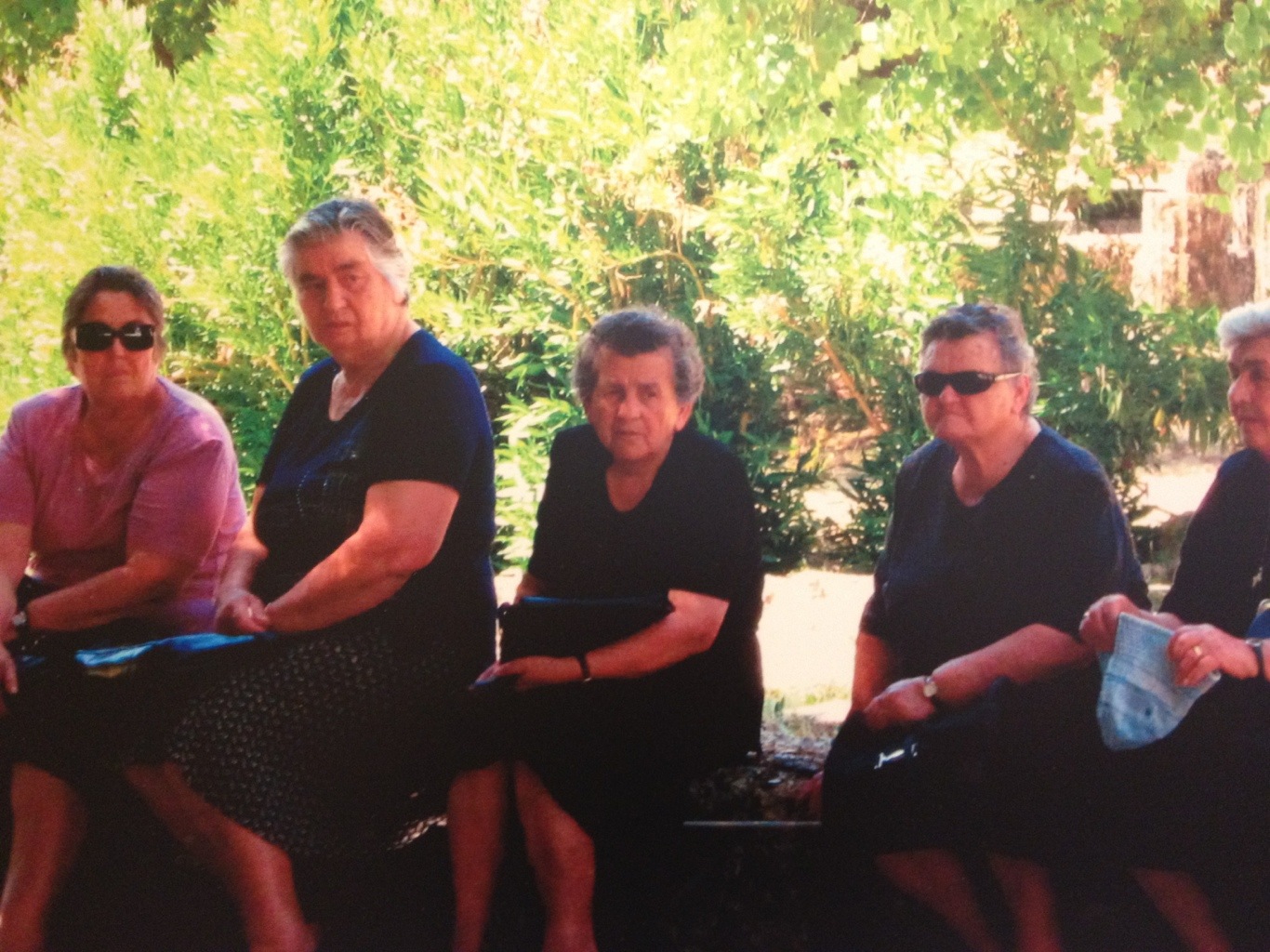
A small and interesting exhibition at UCL on views of the (beautiful) human body over millennia, from Greek sculpture to female bodybuilders, usefully augmented by entries from a student competition of photographs on the same theme. The entries are here; the winner was Mara Gold with her fun “Greek women taking a rest at Olympia” (slightly cropped below; full version on previous link).

20120611-221821.jpg

At tonight’s opening there was a typically academic (gracious, charming, informative, thoughtful) welcome speech from a Vice-Provost of the College, and a more unusual excerpt from a play about women’s attitude to their bodies (Botox, nip’n’tuck etc).

The exhibition brought home the artistic, artificial, constructed nature of how we perceive the human body, and how people, often women, are socially constrained, sometimes at great risk to their health, to amend artificially their appearance towards a perceived ideal. The Vice-Provost’s best example was Japanese women acting and looking consumptive in imitation of Violetta Valéry from La Traviata, but the dramatic excerpt as well made clear the sadness of some women’s fear of ageing.

Posted in Exhibition | Tagged , , | Leave a comment

Writing Britain, at the British Library

Nice title, using the English ambiguity between a participle (“Britain which writes”), like “flying saucer”, and the gerund with an object (“writing (about) Britain”), like “singing songs”. (The National Trust went large on this a few years ago with their slogan “Inspiring Places, Inspiring People”.)

But the exhibition itself, imho, is deeply flawed. There’s no coherence, no logic beyond “How can we show lots of our amazing collection? I know – let’s pull out everything to do with a British location. We can group by type of place: suburbs, wilderness etc.”. That’s it really, so, while there are some amazing things to see here (from the Old English Exeter Book to Lennon’s In My Life, there’s no overall meaning, nothing being learnt. The result is a frustrating experience: you start by walking from case to case, trying to read everything, but actually stopping only at the books or manuscripts that you’ve heard of, or which grab you; pretty soon, as you become aware of the size of the exhibition, a sort of despair sets in, as you realise that you’re not going to be able to pay sufficient attention to everything, nor, as I’ve said, make sense of the whole.

What could they have done? Have an expert, a psychogeographer perhaps, use the (fewer) exhibits to teach us how authors relate to place, so, instead of grouping by “kind of place”, group them, say (I’m thinking aloud), by “attitude towards place” – “nostalgia”, “fear”, “calm” etc. Just do something more interesting than type of place.

Posted in Exhibition | Tagged | Leave a comment

Grayson Perry: “The Vanity of Small Differences”

Victoria Miro Gallery, Hoxton

Six stunning tapestries (woven on a computerised loom, from colour-blocked scans of paintings, according to the guy at the cash desk) depicting a modern Rake’s Progress. Hogarth’s Tom Rakewell has become Tim Rakewell, pink-lensed software magnate of working-class origins, who gets dragged into the middle classes by a posh girlfriend, makes it big, jobs the upper echelons (country estate, swampies with banners urging him to pay more tax), and then dies on a dark and rainy pavement when showing off his Ferrari to his new young wife. The story is similar to that of Ed King (q.v.), but that’s not surprising, as rags-to-riches-to-rags must be one of the oldest stories; it’s the trajectory of tragedy, the hyperbola of hybris (parabola doesn’t alliterate).

Perry’s tapestries are like his pots (some of which are in the gallery), collages of icons of everyday contemporary life, laced with texts. Every picture seems to have an iPhone or iPad, or both, and the texts, words from the mouths of the depicted characters, are fluent, idiomatic expressions of the kind of clichéd speech we’d imagine they’d say. That’s where some of the force and the unease come in, our post-Blair awkwardness at bold class stereotypes. You can’t shrug off your embarrassment, as you know it’s true: people do look, behave and speak like that. There’s a long and fascinating interview with Perry on YouTube where he claims his whole mission is to create discomfort among art audiences. Fair dues.

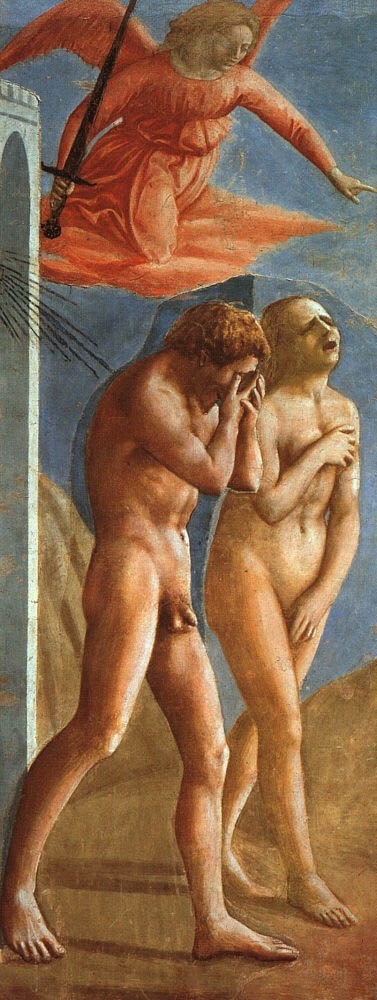
His compositions are wonderful: each tapestry is based on a famous old painting, which gives them a (usually religious) depth. The first tapestry shows a baby in the arms of his mother, in Marian blue, adored by two Heath-style chaps from the council estate, and the last shows Rakewell dying in the pose of a pietà, in the arms of a nurse, again wearing dark blue. The best example is where his posh university girlfriend drags him left to right into the middle classes in the pose of Adam and Eve expelled from Eden (see picture), from a mother on her knees, and a father waving a golf club, to a olive-oil and red-wine dinner party in front of a bookcase. Titles are good: “The Agony in the Car Park”; “The Annunciation of the Virgin Deal”, wherein Rakewell makes it big by signing up with Richard Branson – words always seem on an equal footing with images.

20120607-165104.jpg

So, very contemporary juxtapositions of icons from the past with the ephemera of life today, of images with text, all made discomfiting with some old-fashioned class consciousness (I loved the middle-class dinner-party man’s shirt, stamped all over with “Ironic?”). But why tapestries? As with his pots, tapestry is an old, craft-based art form which sets up expectations counter to his content; it’s a way of creating tension in the viewer. And at a simple level the blocked colour and textures are just great to look at – striking and memorable.

Posted in Art gallery | Tagged , , | Leave a comment

“The Lost Books of the Odyssey” by Zachary Mason

One of the best books I have read. 44 short (some very short) stories on the theme of Odysseus and his return from Troy. Poetic, mysterious, playful, jumping around in time, each one, for lovers of Homer, a pre-sleep daily meditation. To write any more would spoil things: read the stories.

Or read other reviews, like John Swansburg’s, which begins:

There are less hubristic ways to start a career as a novelist than by retelling the story of The Odyssey. For one thing, the original was pretty good. For another, the story has been retold before—by the likes of Alfred Lord Tennyson, James Joyce, and Fritz Lang, to name a few. Yet in The Lost Books of the Odyssey, Zachary Mason has achieved something remarkable. He’s written a first novel that is not just vibrantly original but also an insightful commentary on Homer’s epic and its lasting hold on our imagination.

Posted in Reading | Tagged , , | Leave a comment

“My Week With Marilyn” or “quorum pars parva fui…”

A strangely unthinking film: Colin Clark’s diaries, the basis of the story, are used too straight: too often we hear a bon mot from a Great One (it may be Larry, it may be Sybil Thorndike), overheard at the door by a spellbound Clark; that’s it – it doesn’t fit into the story, but in the film it goes. And this narrator is purely unnuanced: not a squeak of self-awareness, or even of how his influence nudged Monroe towards, rather than from, her destruction.

As in End of the Rainbow, the man we like offers to marry the oppressed woman to save her, from the man we don’t like, from fame, from herself. And, similarly, the woman fails to grasp the rope and is carried on to her doom.

Whenever Marilyn’s around we’re not far from Helen of Troy, but in the Iliad it’s left to Priam to miss his chance of safety: he rejects an offer in Book 7 to return Helen and save his city. Is it all tied up with male infatuation, and the roles which this forces onto beautiful women? Are the good men who offer marriage as a way out thinking entirely with their brains, or is another organ involved?

Posted in Film | Tagged , , , , , , | Leave a comment

Have we missed something?

Marx’s revolution? The proletariat are gliding through glass malls, tapping wirelessly-connected little glass screens. Workers swarm over stately homes, supping National Trust tea, while the rump of an aristocracy skulk in the cottage on the edge of the estate.

Orwell’s dystopia? CCTV cameras, spooks monitoring our banking and our shopping, our conversations and our researching… Populations manipulated by advertising and wars to prop up the system, ensuring, on a world level, untold wealth for a few and abject poverty for most.

“The Kingdom of God is at hand”? We are, with the fading of religion and belief in an afterlife, indeed living in the “last times” / τα εσχατα: this is the only life we have: our last chance to live life as we should.

Have these three predictions all actually happened?

Posted in Stuff | Tagged , , | Leave a comment

The Empty Church

Church has been likened to sport, concerts, or anywhere else where people gather, face the same direction, and share the same experience. But what’s the difference about church? It’s that at football people watch the football, and at a concert the audience watch and listen to the performers, but in a church the supposed object of their attention isn’t actually visible. What we watch and hear, in the place of God, are priests, servers, icons and music. That this is ridiculous is the view of atheists, but theologically it all makes sense. On the cross God empties himself (kenosis / κενωσις, and on a human level we pay respects at the Cenotaph – the ’empty tomb’ (κενοταφος): there’s something powerful about nothingness, emptiness, the empty set. Religious words like holy, blessed are notoriously meaningless, so a fortiori how about God? The Second Commandment bans ‘graven images’, but that’s all we have. Anselm was wrong: non-existence, not existence, is an attribute of a perfect imaginable being.
The ultimate post-Modern trick: in God’s vanishing is his beingcredo quia absurdum.

Posted in Stuff | Tagged , , , | Leave a comment

“The Truth about Lorin Jones” by Alison Lurie

A deft novel about each other and ourselves, about the conflicting stories we hear and tell about us, about prejudice and, more profoundly, the logical unknowability of a person, even ourselves.

Lurie’s characters’ names give this away: the heroine – Polly Alter (“many, another”), and the polyonomy of the remoter heroine, the dead artist Lauren/Laurie/Lolly/Lorin Jones.

Rarely for a novel it ends strongly, with a sustained account of Polly’s imagining two future stories about herself, both unappealing, before settling for a half-forgotten third, the one actually most likely to bring her happiness, precisely in its being the least reliant on status, on the views of others.

Posted in Novel | Tagged | Leave a comment

Hendiadys

For years (well, on and off) I’ve wondered what the point of hendiadys is. It’s an obscure term (which, btw, my iPad wants to correct to ‘he daddy’s’) meaning ‘one through two’, i.e. saying one complex idea as if it were two separate ones. This usually amounts to putting and between two nouns, instead of linking them in more complex ways, such as using of. So, a passionate rage might become passion and rage, or England’s glory England and glory. I’d been taught this at school, and teach it at school, but could never get my head round why writers wrote like this. What did it add? George T. Wright tells us that the word was invented by Servius, the commentator on Virgil, and it’s certainly true that Virgil is full of them. Wright suggests that the effect is to focus our minds more clearly on our perceptions of both elements: in “pateris libamus et auro” (“we drink from cups and from gold”) the goldness of the cups is sharper than if “we drink from golden cups”.

It was typing fast emails which gave me the clue. I’d be writing, say, about an upcoming meeting on school reporting, and would catch myself typing “see you tomorrow to discuss meetings and reports” rather than “the meeting about reports”. It was haste which made me do it, a reluctance to slow down and express myself more thoughtfully. Outside emails, a common example in Modern English is the widespread replacing of try to… with try and…: try and… makes no sense – the trying must be linked to whatever one’s trying to do.

So, at least in English today, hendiadys reflects the speaker’s haste, her impatience with more complex subordination, falling back on just getting out the main ideas, leaving the subtleties of their relationship for the listener to intuit. Is this also part of what Virgil’s doing? Are there examples of hendiadys in (hasty) colloquial Latin?

Posted in Stuff | Tagged , | Leave a comment

“Ed King” by David Guterson

A fantastic book in its own right – i.e. judged as a novel, not an updating of Sophocles’ Oedipus the King. Guterson has an easy, just-self-conscious style – you know you’re being told a story, but he doesn’t intrude – and the whole – characters, scenes, dialogue – comes across vivid and credible.

As a version of Oedipus it also works, though I’m not sure if Guterson is trying to comment on the myth, or on Sophocles, or (just) using elements of the original to make something new. I suspect this last. For example, there is a leitmotiv of blindness, but Ed doesn’t end up blind. Several times Ed’s warned about digging too far, by people who can’t know the truth – and one of these is called Theresa (Teiresias, geddit). But there are a few too many throwaway references which don’t mean anything: someone has edema, a Caleb has the nickname Club, even the decidedly non-virginal Jocasta character is ironically, but meaninglessly, called Diane. It’s a nice idea, though, to begin and end with a chorus of web page comments.

Jocasta/Diane is a larger character than Oedipus/Ed: she starts the novel as a sexually and verbally precocious 15-year old, and ends up not killing herself but a squirrelled-away septuagenarian safe in Tasmania. Most of the novel is focalised through her: her drive, her ups and downs, and her sexuality provide most of the book’s power.

As for Ed, his climb up the software ladder to become a rival to Google (“Pythia (geddit) – even the corporate email addresses are @pmail) lets Guterson build cleverly to the climax, as Ed uses all the search-engine (he’s the “king of search”) power at his disposal, including a Siri-like “Cybil” [why not “Sibyl”?], to find out who his parents are. Guterson, as Sophocles, let’s the truth drip out bit by bit, making the last pages thrill. Ed’s and Diane’s responses to the truth, however, are where Guterson and Sophocles differ (as, meaningfully, did Anouilh in his Antigone, with his Creon’s forcing himself, not into abject exile, but back into the day job). We get unconvincing streams of Ed’s thoughts, concluding with his desire to find Diane and learn what really went on; this noise contrasts with Diane’s silence and (literal) flight. On the other hand, Sophocles’ Jocasta kills herself, and her son/husband blinds himself. The other major difference is that Sophocles’ characters suffer publicly, in the full glare of the open space in front of the royal palace, whereas Guterson’s deal with it all in secret. One question which might be relevant to this secrecy is whether the myth/play of Oedipus exists in their fictional world. I can’t quite remember if any characters mention him; Guterson certainly does on occasion, but, Oedipus’ not being part of their mental furniture would explain their rather confused reaction to what they’ve done.

Once, and once only, does Guterson step aside from his narrative, and give us a Murder-in-the-Cathedral moment: Ed and Diane have picked each other up and are going home for sex; Guterson stops us with:

Okay. Now we approach the part of the story a reader can’t be blamed for having skipped forward to – “flipped forward to” if he or she has a hard copy, but otherwise “scrolled to” or “used the ‘Find’ feature to locate” – the part where a mother has sex with her son. Who could blame you for being interested in this potential hot part, and, at the same time, for shuddering at the prospect of it?

He then asks male and female readers in turn what they would have done in the circumstances, and what difference that knowledge would or should make. Even though, for me, this device sheds no new light on the ‘original’, it’s a sudden and perfectly judged highlight in this modern novel. And now I feel like the apocryphal reviewer of Lady’s Chatterley’s Lover for “Gamekeeper Monthly”, who complained about the excess of irrelevant material crowding out the more interesting stuff on raising pheasants.
Posted in Novel | Tagged , , | Leave a comment